

Oakland, CA Real Estate Agent
Neighborhoods, BART & Housing Styles, Explained
About Oakland
How Do Oakland’s Neighborhoods Differ?
Oakland is large enough that the city name tells you almost nothing on its own: Rockridge and Piedmont Avenue are walkable corridors, Montclair and Piedmont Pines are forested hill roads, the Lake Merritt neighborhoods hold established period homes, and Fruitvale and East Oakland run along the I-880 and International Boulevard corridors. Amanda Velez is an Oakland real estate agent and REALTOR® with Abio Properties, which also keeps an office in Oakland.
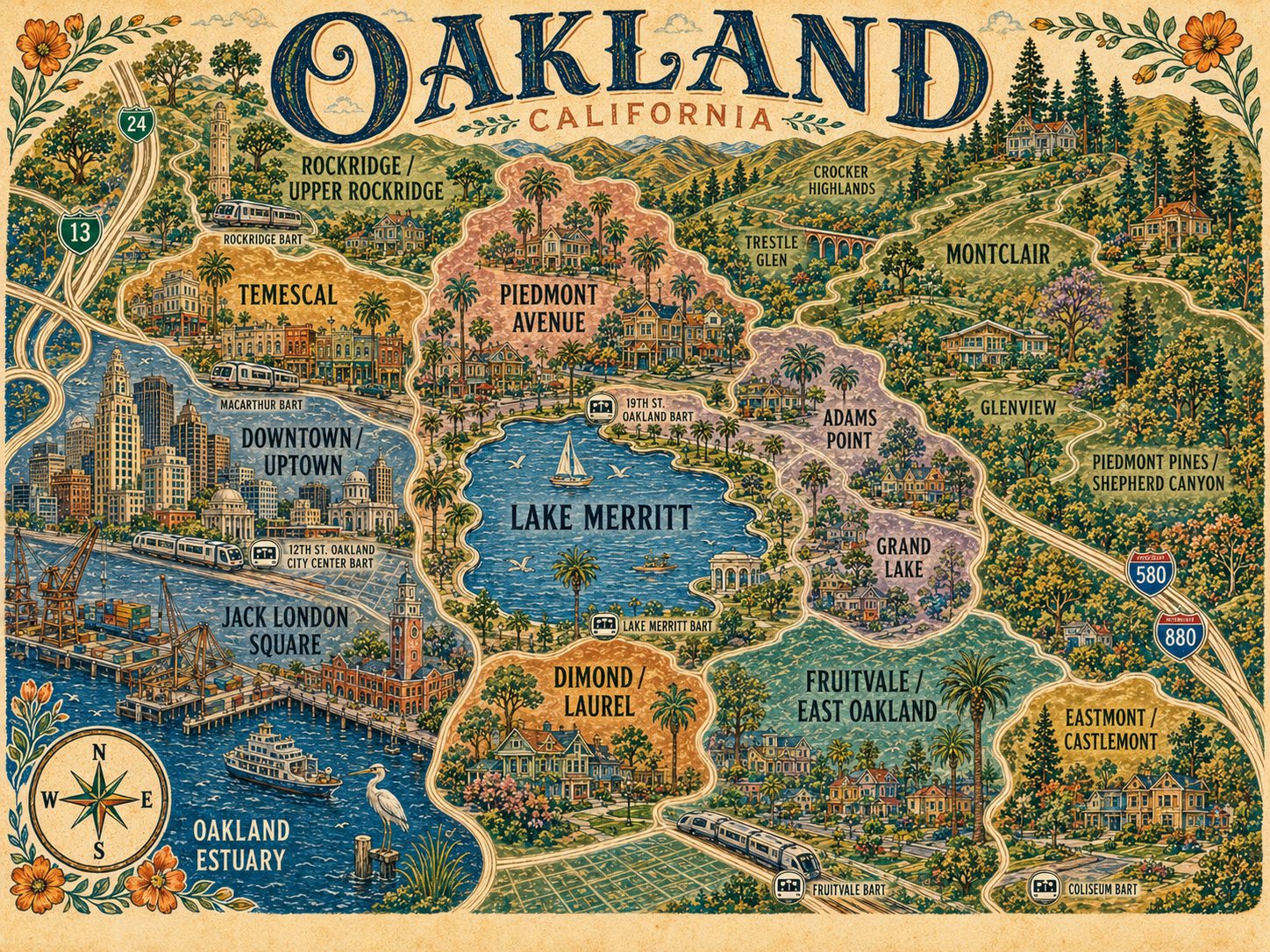
Rockridge runs along College Avenue to the Berkeley border, walkable and anchored by its own BART station, with Upper Rockridge as its quieter hillside extension. Temescal sits in North Oakland off Highway 24 and is known for its restaurants. Piedmont Avenue is a walkable commercial corridor — and, confusingly, is part of Oakland rather than the separately incorporated City of Piedmont. Up in the hills, Montclair is a village of winding forested roads and a compact shopping district off Highway 13, with Piedmont Pines and Shepherd Canyon lower in density and more car-dependent. Around Lake Merritt, Crocker Highlands, Trestle Glen, Glenview, Adams Point, and Grand Lake hold established period homes and walkable streets. The Dimond District and the Laurel are established Craftsman neighborhoods near Fruitvale BART and I-580. Downtown and Uptown are the civic and nightlife core, with Art Deco architecture and the waterfront at Jack London Square. Fruitvale and the East Oakland neighborhoods around Eastmont and Castlemont run along the International Boulevard and I-880 corridors, served by Fruitvale and Coliseum BART, and hold much of the city’s early-twentieth-century flatland housing.
The Craftsman bungalow is Oakland’s signature house, mostly built between the 1900s and the 1920s — shingle or stucco siding, deep covered porches, built-ins, exposed woodwork — with Victorians, Colonial Revivals, and brown shingles appearing more often toward the Berkeley border. Lots are small: the citywide median sits under 5,000 square feet, among the tightest of any major American metro, though hillside zoning sets minimums several times that, so hill lots run considerably larger than flatland ones. Condominiums and townhomes cluster downtown, in Uptown and West Oakland, and along the waterfront, while Rockridge, Montclair, Crocker Highlands, and the hills are overwhelmingly single-family without HOAs. One change worth tracking: as of July 2026, state law SB 79 preempts local zoning within a half mile of qualifying transit stops in Alameda County, allowing significantly taller and denser residential buildings near BART stations. It is new and still settling, so check what currently applies to a specific parcel.
Eight BART stations sit inside the city limits — 12th Street Oakland City Center, 19th Street, Lake Merritt, Fruitvale, Coliseum, MacArthur, Rockridge, and West Oakland — more than almost any other city in the Bay Area, which is why transit access varies so much by neighborhood here. MacArthur to downtown San Francisco runs about twenty minutes, and Oakland International Airport connects to Coliseum station in roughly nine minutes. Interstate 580 runs along the Fruitvale and Dimond corridor, I-880 through the flatlands and port, I-80 west to the Bay Bridge, and Highway 24 northeast through Temescal and Rockridge toward the Caldecott Tunnel. AC Transit fills in the hillier stretches where walking to a station is not realistic.
Oakland Unified does not assign students strictly by address. Since 2005 it has used a choice-based enrollment system in which families rank up to six schools, with placement priority running through continuing students, foster youth, siblings, and staff children before neighborhood boundary residents, then other Oakland residents. Every school does still have a board-approved geographic attendance boundary, and those elementary boundaries have stayed largely unchanged since the system began — useful if you are thinking in decades rather than years. Charter schools run a separate citywide lottery. And one distinction catches buyers out constantly: Piedmont is a separately incorporated city, enclaved entirely within Oakland since 1907, with its own police, fire, parks, and school district funded by its own parcel taxes. The boundary is irregular enough that one side of a street can be Oakland and the other Piedmont. Piedmont Avenue Elementary, despite the name, is an Oakland school, not a Piedmont Unified one. Confirm any specific address with the district rather than assuming.
Lake Merritt is the city’s center of gravity — a 3.4-mile loop around a tidal lagoon, ringed by the 122-acre Lakeside Park, which holds what was designated the country’s first official wildlife refuge back in 1870. In the hills, Redwood Regional Park carries second-growth redwoods more than a century and a half old, and Joaquin Miller Park spans over 500 acres, connecting downhill to Dimond Canyon and uphill to the Bay Area Ridge Trail, with the WPA-era Woodminster Cascade at its center. The food scene is among the most varied in the country, and Oakland Art Murmur and the First Fridays street festival on Telegraph have drawn crowds monthly for close to two decades. Pricing an Oakland home means knowing which side of a block line it sits on. Amanda’s White Glove process starts with a comparable market analysis built from real Oakland sales, then adds a vetted network of local vendors and clear communication from the first call through closing.
Explore the Map
Oakland Neighborhoods, Pinned
Common Questions
Oakland Real Estate: Common Questions
How does school assignment work in Oakland?
Oakland Unified does not assign strictly by address. Families rank up to six schools, with placement priority running through continuing students, foster youth, siblings and staff children before neighborhood boundary residents. Charter schools run a separate citywide lottery.
Is Piedmont part of Oakland?
No. Piedmont is a separately incorporated city, enclaved within Oakland since 1907, with its own police, fire, parks and school district. The boundary is irregular enough that one side of a street can be Oakland and the other Piedmont, and Piedmont Avenue Elementary is an Oakland school despite the name.
How many BART stations are in Oakland?
Eight inside the city limits — 12th Street, 19th Street, Lake Merritt, Fruitvale, Coliseum, MacArthur, Rockridge and West Oakland — more than almost any other city in the Bay Area.