

Berkeley, CA Real Estate Agent
Neighborhoods, Schools & Architecture, Explained
About Berkeley
What Should Buyers and Sellers Know About Berkeley, CA?
Berkeley’s signature house is the brown shingle, its lots are small by East Bay standards at a citywide median near 5,000 square feet, and a Middle Housing ordinance adopted in November 2025 now permits multiple units by right on most residential parcels. Amanda Velez is a Berkeley real estate agent and REALTOR® with Abio Properties, working from the Berkeley Hills and Elmwood down to Fourth Street.
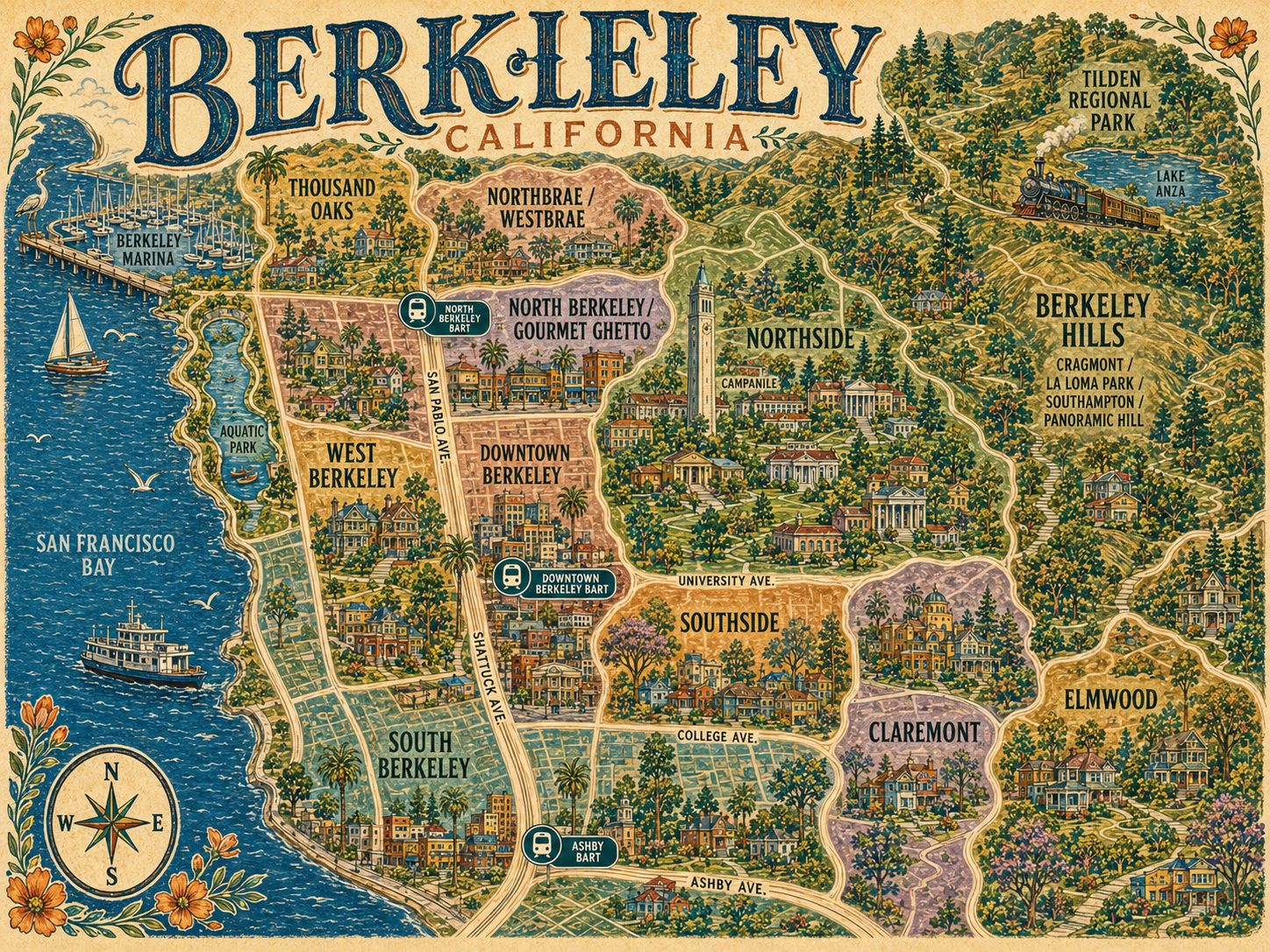
Berkeley’s neighborhoods differ from one another more than in most cities its size. Downtown is the transit and arts hub, with mid-rises around the main BART station; Southside beside campus is dense and student-oriented, while Northside is quieter and draws faculty and graduate students. The Berkeley Hills — Cragmont, La Loma Park, Southampton, and Panoramic Hill among them — are view neighborhoods of stairway streets and larger lots backing onto Tilden Regional Park. Claremont holds the grandest homes, centered on the historic Claremont Hotel, and Elmwood pairs Craftsman bungalows and brown shingles with the College Avenue shopping street. North Berkeley, the Gourmet Ghetto, runs along the Shattuck and Walnut corridor. Thousand Oaks is leafy and known for its rock outcroppings; Northbrae and Westbrae are early-twentieth-century planned subdivisions along Solano Avenue; South Berkeley centers on Ashby BART and its long-running flea market; and West Berkeley, around Fourth Street and the Marina, has moved from industrial to artisanal retail and housing.
The signature style is the brown shingle — the First Bay Tradition of roughly 1895 to 1917, associated with Bernard Maybeck and the Hillside Club — alongside Craftsman bungalows, Spanish Revival, Victorians, and mid-century homes in the hills. Lots are small by East Bay standards, with a citywide median around 5,000 square feet and the larger parcels concentrated in the hills and around Claremont and Elmwood. One recent change matters for anyone weighing what a lot could become: since November 2025 Berkeley’s Middle Housing ordinance has allowed two to six units by right on most residential lots, up to eight on a standard 5,000-square-foot lot, excluding the very high fire hazard areas in the hills. That is evolving policy rather than settled ground, so check the current rules for a specific parcel.
Three BART stations serve the city — Ashby, Downtown Berkeley, and North Berkeley, all on the Richmond line — and Downtown Berkeley to San Francisco runs roughly half an hour. Interstate 80 skirts the western edge with exits at Ashby, University, and Gilman; Highway 13 climbs through the hills toward I-580; Highway 24 heads east through the Caldecott Tunnel; and AC Transit buses fill in between. Berkeley is one of the few places in the East Bay where living without a car is realistic — the citywide Walk Score sits in the mid-eighties, and downtown is in the high nineties.
Schools work differently here than anywhere else in the East Bay, and it is the fact most worth understanding before you buy. Berkeley Unified School District covers the whole city and assigns elementary students by lottery across three attendance zones — Northwest, Central, and Southeast — weighing zone residency alongside the district’s diversity criteria rather than guaranteeing the closest school. Middle school assignment follows a similar three-zone plan across King, Longfellow, and Willard, and every student in the district attends the same high school, Berkeley High. An address places you in a zone; it does not reserve a seat at a particular school. Confirm the current zone and the enrollment process directly with the district.
Tilden Regional Park wraps the eastern hills with more than two thousand acres, a botanic garden, Lake Anza, a 1911 carousel, the Little Farm, and a steam train. UC Berkeley sets much of the city’s rhythm, and the food culture that grew up around it — Chez Panisse and the Cheese Board in the Gourmet Ghetto, Monterey Market, the farmers markets — is a real draw rather than a marketing line. West of the freeway, the Berkeley Marina and the shoreline give the flat side of town its own open space. With a housing stock this specific, a Berkeley valuation depends on telling a brown shingle from a stucco bungalow. Amanda’s White Glove process pairs a comparable market analysis drawn from real Berkeley sales with a vetted vendor network and steady communication through closing.
Explore the Map
Berkeley Neighborhoods, Pinned
Nearby Communities
Also Serving
Common Questions
Berkeley Real Estate: Common Questions
How does school assignment work in Berkeley?
Berkeley Unified assigns elementary students by lottery across three attendance zones rather than by neighborhood, weighing zone residency alongside the district’s diversity criteria. An address places you in a zone but does not reserve a seat at a particular school, so confirm the current zone and process with the district.
How many BART stations are in Berkeley?
Three — Ashby, Downtown Berkeley and North Berkeley, all on the Richmond line. Downtown Berkeley to San Francisco runs roughly half an hour.
What is a Berkeley brown shingle?
The city’s signature house style, from the First Bay Tradition of roughly 1895 to 1917 and associated with Bernard Maybeck and the Hillside Club. Craftsman bungalows, Spanish Revival, Victorians and hill mid-century homes also appear widely.