

Antioch, CA Real Estate Agent
Neighborhoods, Schools & eBART, Explained
About Antioch
What Should Buyers and Sellers Know About Antioch, CA?
Antioch spans a wider range of housing ages than any of its East County neighbors — Rivertown homes from the 1870s, mid-century ranch tracts, 1990s subdivisions, and new construction along the Highway 4 bypass — and its neighborhood names are informal agent labels rather than official designations. Amanda Velez is an Antioch real estate agent and REALTOR® with Abio Properties.
The same area can therefore appear under more than one name. Downtown and Rivertown are the historic riverfront core, with commercial buildings and homes dating to the 1870s, the waterfront promenade, a farmers market, and the marina. Working south and east, Lone Tree covers several eras at once — Lone Tree Meadows is 1960s and 1970s tract housing, while Lone Tree Estates was built in the late 1990s with its own pool, courts, and clubhouse. Dallas Ranch and Country Hills are the central, 1980s-to-2000s suburban stretch. Deer Valley in the south is the newer master-planned side of the city, built largely within the last two decades on lots around 7,000 square feet. Black Diamond Estates and the neighborhoods near the Black Diamond Mines preserve run to larger lots and more privacy, Mira Vista Hills sits on the southeastern hillsides with river and hill views, and Sand Creek and the Bridgehead corridor near the Highway 4 bypass are where most current new construction is going.
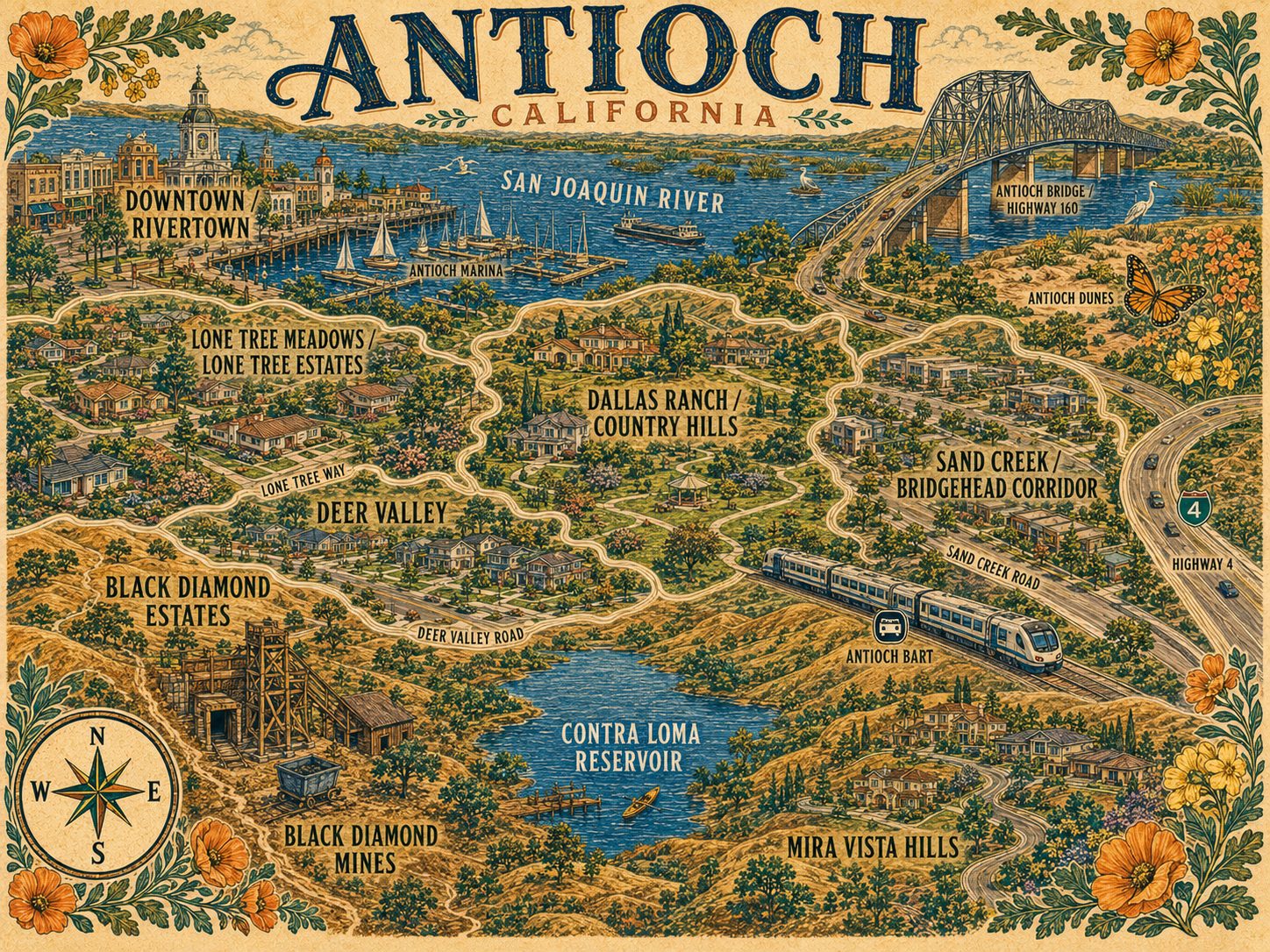
That spread means the housing stock ranges from Rivertown homes more than a century old through mid-century ranch tracts and 1990s subdivisions to homes finishing construction now — a genuinely different profile from Brentwood next door, where most of the city went up after 2000. HOAs exist but tend to be modest, concentrated in the newer subdivisions and the older amenity communities like Lone Tree Estates, while many established tract neighborhoods have none at all.
Antioch is the only city in far East County with a rail terminal of its own, and how that rail works surprises people. The eBART extension opened in 2018 and runs about ten miles from a transfer platform near Pittsburg/Bay Point, through Pittsburg Center, to the Antioch station on Slatten Ranch Road. It uses diesel trains rather than BART’s third rail, which means there is no direct train to San Francisco — every trip involves a cross-platform transfer at Pittsburg/Bay Point. Commonly reported times to downtown San Francisco run about an hour to an hour and a quarter including that transfer, and driving is roughly forty-five miles. State Route 4 is the primary corridor, with the tracks running in its median from Concord out to Antioch. Treat any of these as ranges rather than fixed numbers.
Schools need checking address by address here more than in most of the East Bay, because Antioch’s district boundaries do not follow the city limits in either direction. Antioch Unified serves the majority of the city and also extends into part of Oakley west of Empire Avenue, while small portions of Antioch fall under Brentwood Union Elementary and Liberty Union High School District instead — and some new-construction homes near the Brentwood border are marketed as zoned for Brentwood’s schools rather than Antioch’s. Within Antioch Unified the general pattern is that the southern neighborhoods feed Dallas Ranch Middle and Deer Valley High, while central, northern, and downtown addresses feed Antioch High. The district also runs Dozier-Libbey Medical High as a specialized option. Confirm the assignment for a specific address with the district rather than assuming from the neighborhood or the city line.
The Delta is the point of the place. The city-owned Antioch Marina has more than 300 slips, a boat launch, guest berthing, and a fuel dock, with open water out to Sherman Lake and Winter Island for striped bass, salmon, steelhead, and sturgeon; it is also an official trailhead on the San Francisco Bay Water Trail, so kayaks and canoes launch from the same spot. San Joaquin Yacht Harbor and New Bridge Marina near the Antioch Bridge serve boaters as well. Inland, Black Diamond Mines Regional Preserve carries more than sixty miles of trails through the hills above the southern neighborhoods. Rivertown’s waterfront district has been the focus of successive revitalization efforts and remains the city’s historic center. With Antioch homes spanning a century and a half of construction, the comparables have to be chosen carefully. Amanda’s White Glove process does exactly that, alongside a vetted network of local vendors and clear communication from first conversation through closing.
Explore the Map
Antioch Neighborhoods, Pinned
Nearby Communities
Also Serving
Common Questions
Antioch Real Estate: Common Questions
Is there a direct BART train from Antioch to San Francisco?
No. eBART uses diesel trains rather than BART’s third rail, so every trip involves a cross-platform transfer at Pittsburg/Bay Point. Times to downtown San Francisco commonly run about an hour to an hour and a quarter including the transfer.
Which school district serves Antioch?
Mostly Antioch Unified, which also extends into part of Oakley west of Empire Avenue. Small portions of Antioch fall under Brentwood Union Elementary and Liberty Union High instead, and some new-construction homes near the Brentwood border are marketed as zoned for Brentwood’s schools — confirm the exact address with the district.
What are the main neighborhoods in Antioch?
Downtown and Rivertown on the waterfront, Lone Tree spanning several building eras, Dallas Ranch and Country Hills through the middle, Deer Valley in the newer master-planned south, Black Diamond and Mira Vista Hills on the southeastern hillsides, and Sand Creek with the Bridgehead corridor where current construction is going.